
A visual guide to building security into modern software delivery — from the first design decision to production monitoring.
WHY THIS MATTERS
Security can no longer be the final checkpoint.
Modern teams release software faster, rely heavily on open-source packages, deploy into cloud environments, and operate through APIs, containers, and distributed services. That speed creates business value — but it also means security issues can move from a developer laptop to production much faster than before.
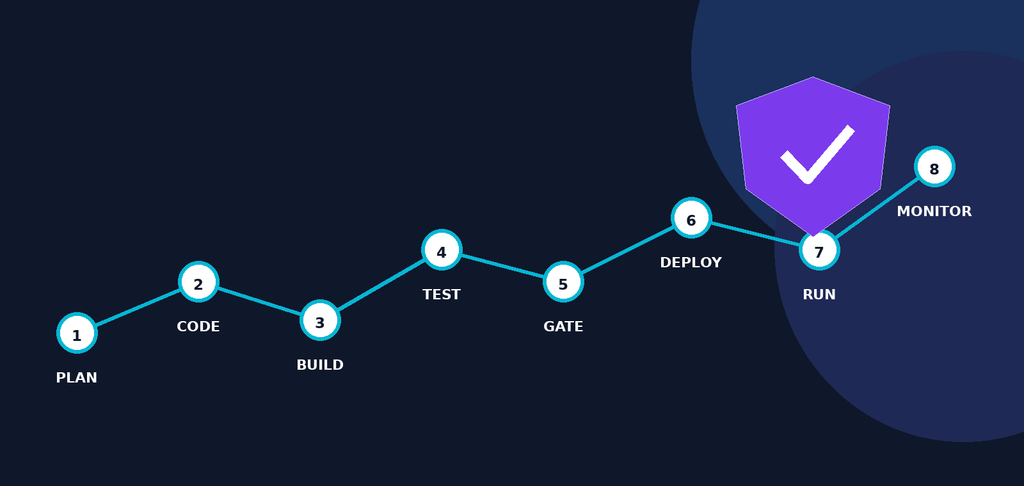
DevSecOps is the practice of making security part of the same engineering system used to design, build, test, deploy, and operate software. Instead of treating security as a late-stage audit, teams create continuous security feedback throughout the software delivery lifecycle.
| Core idea: Security should be a property of the delivery process — not a meeting that happens after development is “done.” |
What DevSecOps actually changes
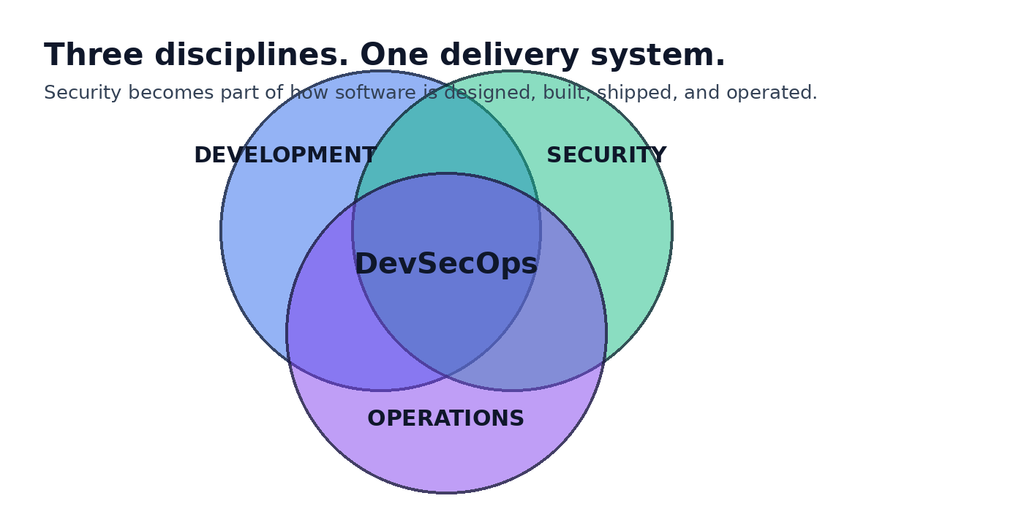
DevSecOps is not simply DevOps plus a vulnerability scanner. It changes when security decisions are made, who owns them, and how consistently they are enforced. The goal is to give developers fast, actionable feedback while giving security teams visibility and policy control at scale.
| Earlier feedback Find design, code, dependency, and configuration risk before release. | Automated controls Run security checks in the same pipelines that build and deploy software. | Shared ownership Developers, platform teams, operations, and security work from one risk model. |
FROM LATE TESTING TO CONTINUOUS SECURITY
Shift Left: move security closer to the decision.
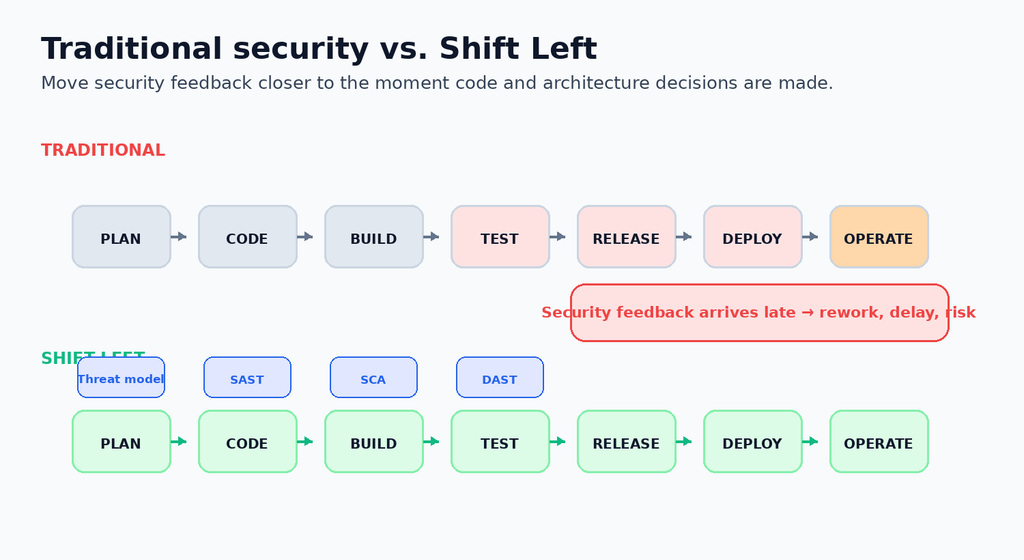
In a traditional model, a large portion of security testing happens near release or after deployment. The problem is timing: architecture is already implemented, dependencies are already embedded, and deadlines are already close.
Shift Left means adding security activities earlier in the lifecycle — during planning, coding, pull requests, builds, and test environments. This does not remove production security. It reduces the number of preventable issues that reach production in the first place.
| Think “feedback,” not just “testing” A scanner that reports 500 findings two weeks later is less useful than a focused check that gives the developer one actionable finding inside the pull request. |
What moves left?
- Threat modelling and security requirements during design.
- Static analysis and secure coding checks during development.
- Dependency and license checks before packages are promoted.
- Secret detection before credentials enter source history.
- Infrastructure and container configuration checks before deployment.
AUTOMATING SECURITY IN CI/CD
Turn security policy into delivery logic.
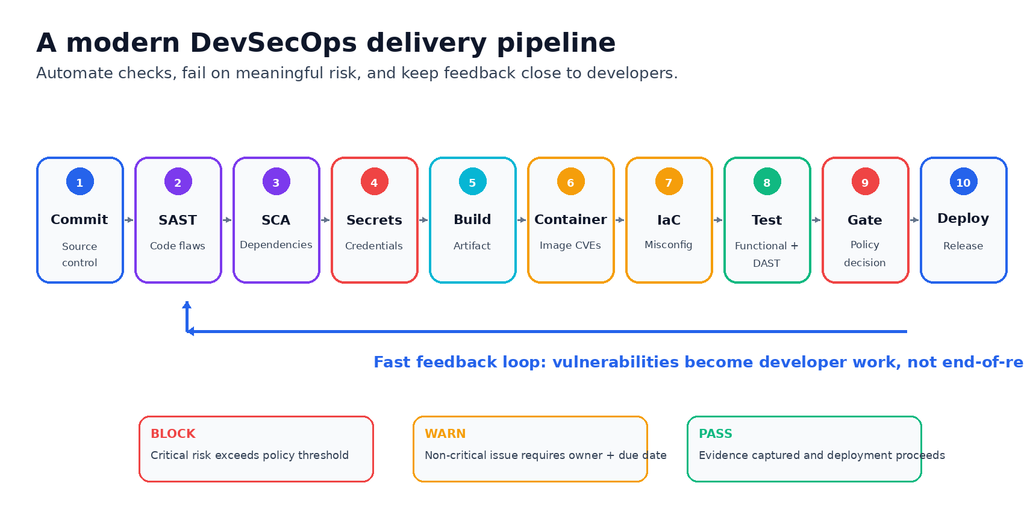
A mature pipeline does not ask developers to manually visit multiple security dashboards for every release. The pipeline runs checks automatically, returns findings to the workflow where engineers already work, and uses risk-based policies to decide whether a release should continue.
A useful pipeline distinguishes signal from noise
Not every finding should block delivery. Teams typically define which issues are blocking, which can be accepted temporarily, who can approve exceptions, and how remediation is tracked. The important part is that the policy is explicit, repeatable, and auditable.
| Weak gate “Any vulnerability = fail.” This usually creates alert fatigue and workarounds. | Strong gate Block exploitable or policy-critical risk; track the rest with ownership and deadlines. |
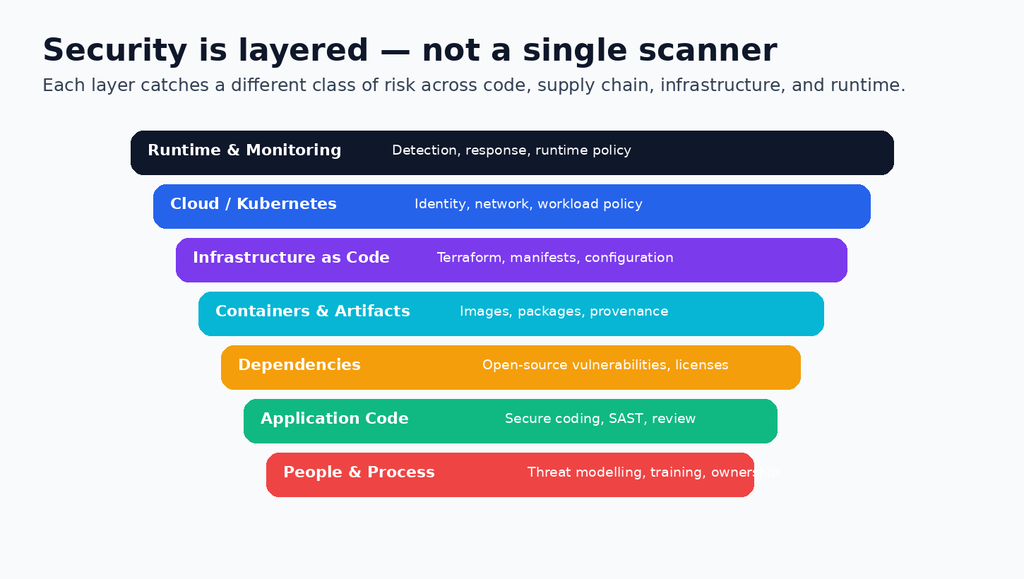
Defense in depth
No single tool can secure a modern application. Code scanners do not replace identity controls. Container scanning does not replace runtime monitoring. DevSecOps works best as a layered system where controls overlap and compensate for one another.
TOOL LANDSCAPE
Choose capabilities before choosing vendors.
A DevSecOps stack should be built around the risks you need to control and the workflows your teams already use. The examples below are common categories, not a requirement to install every tool.
| Capability | What it helps with | Example tools |
|---|---|---|
| SAST | Find insecure code patterns before runtime. | Semgrep, CodeQL, SonarQube, Snyk Code |
| SCA / dependency security | Identify vulnerable open-source packages and dependency risk. | Dependabot, OWASP Dependency-Check, Snyk Open Source |
| Secret scanning | Prevent API keys, tokens, and credentials from entering repositories. | Gitleaks, TruffleHog |
| Container scanning | Inspect images and operating-system packages for known vulnerabilities. | Trivy, Grype, Snyk Container |
| IaC scanning | Detect insecure Terraform, Kubernetes, and cloud configuration before deployment. | Checkov, tfsec, Terrascan |
| DAST | Test running applications for externally observable weaknesses. | OWASP ZAP and similar scanners |
| Runtime / policy | Detect suspicious behavior and enforce workload or admission policies. | Falco, Kyverno, OPA/Gatekeeper |
| Avoid tool sprawl More scanners do not automatically create more security. Prefer a small number of well-integrated controls with clear ownership, deduplicated findings, and measurable remediation. |
Security is a shared engineering responsibility
The strongest DevSecOps programs make secure behavior the easiest behavior. Developers receive useful guardrails, platform teams provide secure defaults, operations protects runtime environments, and security teams define policy, advise on high-risk design decisions, and help teams respond to threats.
| Developers Secure coding, fixes, dependency hygiene | Platform / DevOps Pipeline controls, secrets, cloud guardrails | Security Policy, threat models, review, incident expertise | Operations / SRE Runtime hardening, monitoring, response |
PUTTING IT INTO PRACTICE
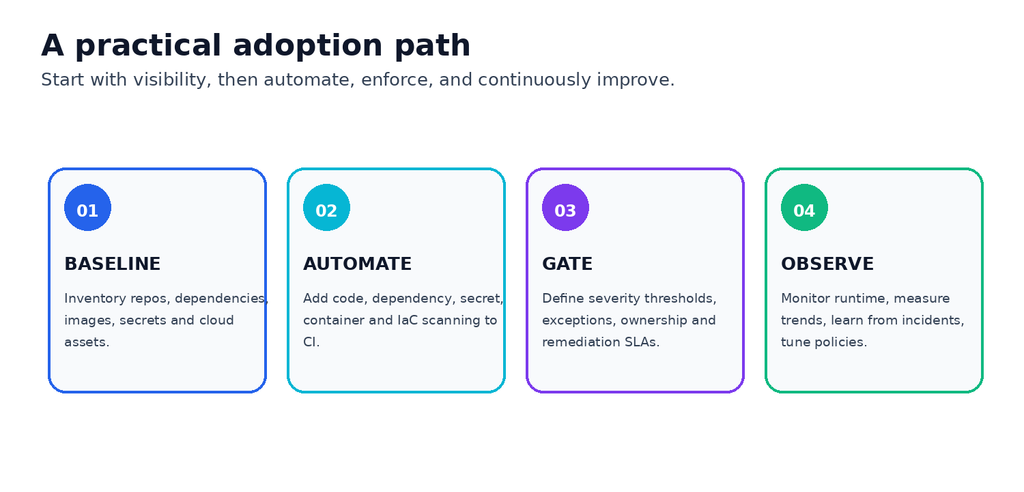
Start small. Automate what matters. Improve continuously.
DevSecOps adoption does not require rebuilding the entire engineering organization at once. A practical approach is to start by understanding the current attack surface and delivery process, then progressively add automated controls and policy gates.
Measure outcomes, not scanner activity
The goal is not to maximize the number of findings. It is to reduce meaningful risk while preserving delivery speed. Useful program metrics focus on how quickly teams detect and remediate important issues and how often preventable risk reaches later stages.
| Time to detect How quickly material risk is surfaced. | Time to remediate How quickly owners resolve validated issues. | Escape rate How many issues are first discovered late or in production. |
| Coverage How much of the delivery surface is continuously checked. | Exception age How long accepted risk remains open. | Developer friction Whether controls help or slow engineers unnecessarily. |
A simple team checklist
- Do we know which repositories, services, dependencies, images, and cloud resources matter most?
- Can developers see security feedback inside pull requests and CI pipelines?
- Are critical risks blocked automatically, with a controlled exception process?
- Are secrets and production credentials kept outside source code and build logs?
- Are container and infrastructure configurations checked before deployment?
- Do we monitor runtime behavior and have an incident response path?
- Do findings have a clear owner, priority, and expected remediation time?
Final thought
| DevOps asks: “How can we deliver software faster?” DevSecOps adds an equally important question: “How can we make that speed safe and sustainable?” |
The most effective security programs do not stand outside engineering and inspect the finished product. They become part of engineering itself — embedded in architecture decisions, pull requests, pipelines, deployment policies, cloud guardrails, and runtime monitoring.
When security feedback is early, relevant, and automated, teams can move quickly without treating risk as someone else’s problem. That is the real promise of DevSecOps: not slower delivery in the name of security, but a delivery system designed to make secure software easier to build.
Ship fast — but make security part of the path to production, not a checkpoint at the end.
#DevSecOps #DevOps #CyberSecurity #CloudSecurity #SoftwareEngineering #CICD #Kubernetes #ApplicationSecurity
written by Pratyush Gupta
Full Stack Developer, Yutitech Innovations Pvt Ltd
