A demo is a promise made under conditions that will never exist again.
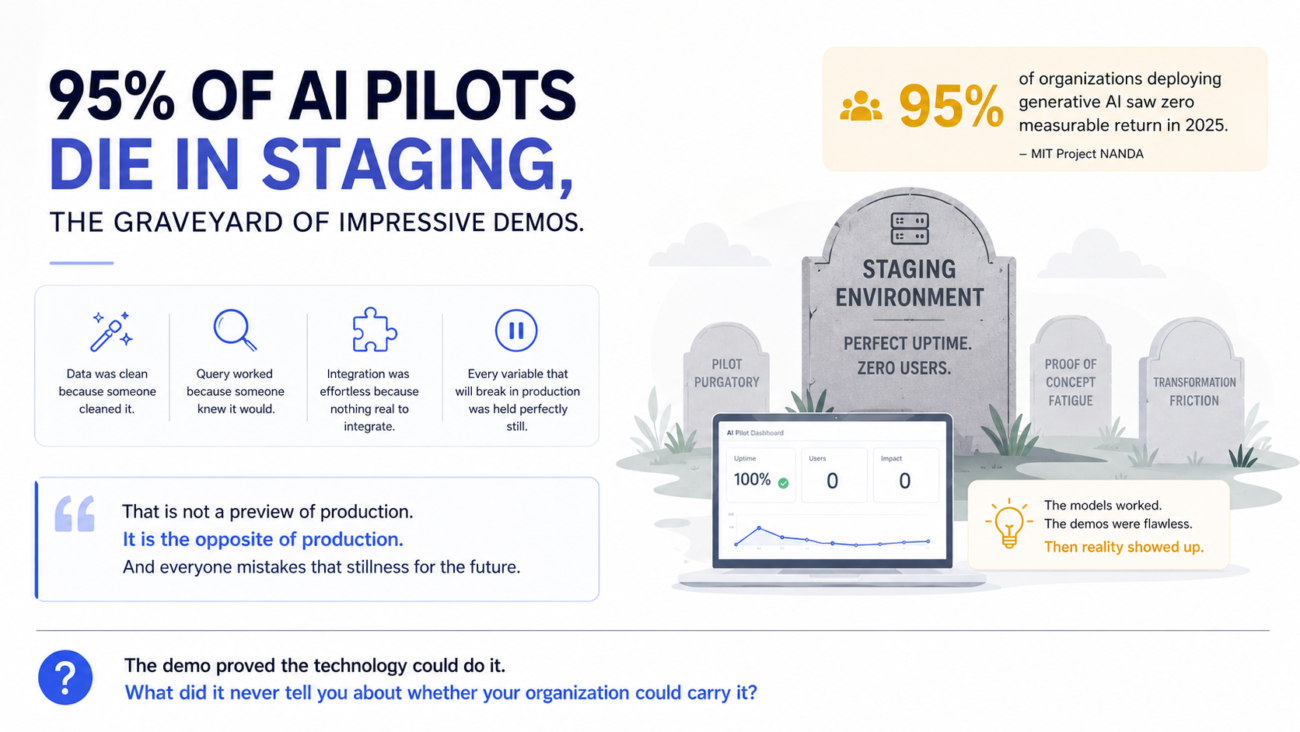
The data was clean because someone cleaned it. The query worked because someone knew it would. The integration was effortless because there was nothing real to integrate.
Every variable that will eventually break your system in production was, for those thirty minutes, held perfectly still.
That is not a preview of production. It is the opposite of production.
And everyone in the room mistakes that stillness for the future.
🪦 The graveyard nobody talks about
So the demo gets applause. The project gets funded. The system gets sent to the place where promises go to wait.
There is a graveyard most companies never mention. It has perfect uptime and zero users. It is called the staging environment.
MIT’s Project NANDA studied over 300 AI initiatives in 2025 and found that 95% of organizations deploying generative AI saw zero measurable return. Not low return. Zero.
The models worked. The demos were flawless. Then the conditions that made the demo possible quietly disappeared because they were never going to survive contact with the real world.
🗣️ What nobody says in the post-mortem
They do not call it a failure. They call it a learning. The pilot is wrapped up, the budget reallocated, and six months later a new one begins on top of the same unresolved problems.
The industry has built a whole vocabulary to soften this. Pilot purgatory. Proof-of-concept fatigue. Transformation friction.
Gentle phrases for an ungentle truth: we believed a promise made under conditions we then dismantled and we are not sure how to admit that to ourselves.
⚙️ The model was almost never the problem
The failures cluster around data readiness, integration, and the mismatch between what a pilot tests and what production actually demands.
In the demo, the data was assembled by hand. In production, it lives across legacy systems, disconnected databases, and a spreadsheet last touched in 2019 by someone who left in 2021.
In the demo, there was nothing to integrate. In production, the system must speak to an ERP that is fourteen years old, was never built for APIs, and is understood by exactly three people – none of whom were in the room.
In the demo, an excited team owned it. In production, nobody does. No one defined what success looks like after launch. No one planned for the model being confidently wrong at 2am on a Tuesday.
❓ The question the demo can never answer
A demo asks , can the technology do this? Production asks – can this organization carry it?
The first is thrilling and earns applause. The second is unglamorous and earns silence in budget meetings.
But the first has been answered for years. The technology can almost always do the thing.
In 2025, enterprises spent $684 billion on AI. More than $547 billion of it failed to deliver its intended value.
That did not evaporate because the models were not good enough. It evaporated in the distance between a promise and the conditions required to keep it.
🔍 How we think about this at Yutitech
We have learned to distrust the demo. Not the technology — the demo. The seduction of watching something work under conditions designed to make it work.
So before we build, we ask what a demo cannot:
Where does this data actually come from when no one is hand-cleaning it? What fragile, undocumented system does this need to touch? What does success look like in month six, not the first thirty minutes? And when it is wrong, because it will be- what stands between that wrong answer and a real consequence?
None of these questions earn applause. They are simply the difference between a system that lives in production and one that lives in the graveyard- perfectly functional, perfectly silent, still keeping a promise no one can use.
◈ The demo proved the technology could do it. What did it never tell you about whether your organization could carry it?
#AIEngineering #PilotParalysis #ProductionAI #BackendEngineering #LLMOps #EnterpriseAI #SystemDesign #YutitechInnovations
written by Sarthak Kumar
AI Engineer, Yutitech Innovations Pvt Ltd
